Home heating: why does it pollute?
In previous article we talked about pollution in cities and we identified 4 primary sources, traffic, domestic heating, industry and agriculture. In this post we would like to focus on heating with some tips to better manage its emissions.
What are the emissions from home heating?
As we saw in the previous article, from 1990 to today there has been a general decline in emissions into the atmosphere . But how are things in the non-industrial heating sector, which mainly includes domestic heating alongside commercial and public heating?
Unfortunately not well, because with the exception of SOx emissions, this sector has shown itself to be going against the trend compared to the others, with significant increases in emissions of all harmful gases. Let's look at them in detail, analyzing the cause of these increases.
As we mentioned, SOx represents an exception, with a decrease of 87% compared to 1990 and an amount, in total SOx emissions, of 9%. This reduction was due to the replacement of coal, diesel and diesel fuel with natural gas and LPG. Furthermore, it should be noted that coal has been banned from use in residential and commercial heating, while the percentages of sulfur present in diesel and gas oil have been significantly reduced by law over the years.
The positives end here, as we will now see, NOx, NMVOC, CO, PM10 and PM2.5 have all seen a considerable increase for the residential/public/commercial sector. Here are the details.
NOx emission increased by 36% . Non-methane volatile components (NMVOC) increased by 71% representing 19% of the total. The carbon monoxide increased by 62% compared to 1990, contributing 64% of total emissions.
As regards PM2.5 and PM10, the sector in question constitutes the main source of emissions with data that is not at all comforting. For PM10 the contribution is 55% of the total, with a increase of approximately 41% compared to 1990. Same increase for PM2.5 which leads the entire sector to account for 67% of the total.
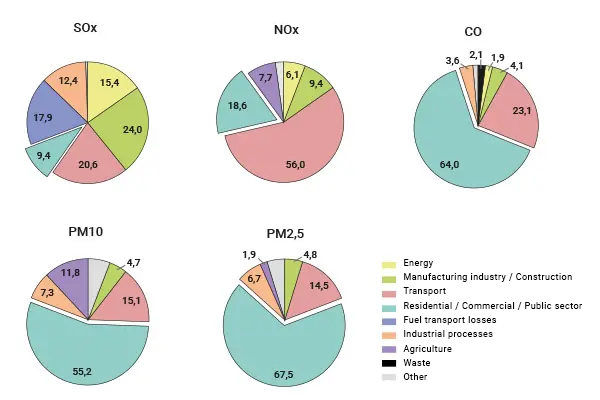
Source: Ispra Report - Informative Inventory Report 2020 - Italian Emission Inventory 1990-2018
The cause of these increases lies mainly in the use of biomass (wood) or solid biofuels (pellets) as fuel for domestic heating systems. The promotion of renewable energy has also increased the use of biomass as it is a renewable source, but the strategy has proven to have a negative impact on air quality.
Added to this is that the adoption of new technologies for residential heating has not had the same acceleration that has occurred, for example, in the heating sector. transport . This is for two main reasons: average life of the boiler and the lack of adequate incentives for the renewal of plants (with the exception of the steps in this direction taken in recent years).
Why boiler maintenance must be carried out
Boiler maintenance is often seen as a cost that would be willingly avoided if it were not mandatory. In reality, the correct and periodic maintenance helps to keep emissions to a minimum, allowing for energy savings . How come? To understand this we must make a brief and simplified reference to how combustion occurs.
In an ideal combustion, fuel and oxidizer are present to such an extent that both are used completely, thus extracting the maximum amount of energy in the form of heat. If we take methane (CH4) for example, we would have a perfect combustion if for each atom of methane we used 2 atoms of oxygen as an oxidizer, so as to produce heat plus one molecule of CO2 and two of H2O as a result.
This type of combustion is naturally an ideal model, because in reality air is used as an oxidant, which does not only contain oxygen, and it is very difficult to achieve a perfect ratio between oxidant and fuel with the consequent production of harmful combustion waste .
Part of maintenance work on a boiler is precisely to ensure that the combustion process that takes place inside it remains, over the years, the as close as possible to the ideal reducing efficiency losses due to normal wear.
Maintenance therefore has two benefits : preserves the efficiency of the boiler, and therefore leads to a energy saving ; allows you to monitor and reduce harmful emissions, safeguarding the environment .
What is the ideal temperature in the house?
Therefore, if a contribution to the containment of emissions in the residential sector certainly comes from the periodic inspection of the boiler, another help that each of us can give is by setting the comfort temperature.
It goes without saying that the temperature level you want to have in your home brings with it a corresponding fuel consumption with related emissions. It has been calculated that from 20 °C onwards the cost increases by approximately 6/7% per degree . But is there a recommended temperature to keep?
The WHO recommends do not exceed 21 °C , which allows you to have an optimal level of well-being at home. Each of us will thus be able to verify the difference between what is recommended and the temperature maintained. How do you fit in? Would you have savings, or do you already have the same or lower value?
Finally, there is another precaution that we can observe when it comes to home heating, namely the use of a chronothermostat .
It should in fact be noted that the boiler, after an interval in which it has remained off, takes more time and energy to reach a certain level of heat than it would have used if it had remained on.
Thanks to the possibility of setting a comfort and reduction temperature and the use of time bands to manage switching on and off, the chronothermostat allows you to reduce energy costs , as it activates heating only when really needed. Furthermore, the comfort and reduction setting allows you to optimize the time to reach the desired temperature.